

When Drawing Lewis Structures, Which Atoms Must Receive Lone Pairs First?
Representing Valence Electrons in Lewis Symbols
Lewis symbols use dots to visually stand for the valence electrons of an atom.
Learning Objectives
Recall the Lewis construction ceremonial for representing valance electrons
Key Takeaways
Key Points
- Electrons exist outside of an cantlet 'southward nucleus and are establish in principal energy levels that contain only upwards to a specific number of electrons.
- The outermost principal energy level that contains electrons is called the valence level and contains valence electrons.
- Lewis symbols are diagrams that show the number of valence electrons of a item element with dots that represent lonely pairs.
- Lewis symbols do not visualize the electrons in the inner main energy levels.
Key Terms
- principal energy levels: The different levels where electrons can be found and that occur at specific distances from the cantlet'south nucleus. Each level is associated with a item free energy value that electrons within it have.
- valence level: The outermost chief free energy level, which is the level furthest away from the nucleus that still contains electrons.
- valence electrons: The electrons of atoms that participate in the formation of chemical bonds.
- Lewis symbols: Symbols of the elements with their number of valence electrons represented as dots
Lewis symbols (as well known as Lewis dot diagrams or electron dot diagrams) are diagrams that represent the valence electrons of an atom. Lewis structures (also known as Lewis dot structures or electron dot structures) are diagrams that correspond the valence electrons of atoms inside a molecule. These Lewis symbols and Lewis structures help visualize the valence electrons of atoms and molecules, whether they exist as lone pairs or within bonds.
Principal Energy Levels
An atom consists of a positively charged nucleus and negatively charged electrons. The electrostatic allure betwixt them keeps electrons 'leap' to the nucleus and so they stay inside a certain altitude of it. Careful investigations have shown that not all electrons within an atom have the same boilerplate position or free energy. We say the electrons 'reside' in different principal energy levels, and these levels exist at different radii from the nucleus and have rules regarding how many electrons they tin can accommodate.

Chief energy levels of gilt (Au): The figure shows the organization of the electrons around the nucleus of a gold (Au) atom. Notice that the first energy level (closest to the nucleus) can have just ii electrons, while more than electrons tin 'fit' within a given level further out. The number of electrons in each level is listed on the upper right corner of the effigy. Notice that the outermost level has but one electron.
As an example, a neutral atom of gold (Au) contains 79 protons in its nucleus and 79 electrons. The first primary energy level, which is the 1 closest to the nucleus, can concord a maximum of two electrons. The second primary energy level can have 8, the third can accept 18, and and then on, until all 79 electrons have been distributed.
The outermost master free energy level is of great involvement in chemical science considering the electrons it holds are the furthest away from the nucleus, and therefore are the ones most loosely held by its attractive force; the larger the distance betwixt two charged objects, the smaller the strength they exert on each other. Chemical reactivity of all of the unlike elements in the periodic table depends on the number of electrons in that last, outermost level, called the valence level or valence shell. In the example of gilded, at that place is merely one valence electron in its valence level.
Octet of Valence Electrons
Atoms gain, lose, or share electrons in their valence level in order to accomplish greater stability, or a lower energy state. From this perspective, bonds between atoms grade so that the bonded atoms are in a lower energy land compared to when they were by themselves. Atoms can achieve this more stable state by having a valence level which contains as many electrons as information technology tin can concur. For the starting time principal energy level, having 2 electrons in it is the nearly stable arrangement, while for all other levels outside of the start, eight electrons are necessary to achieve the well-nigh stable state.
Lewis Symbols
In the Lewis symbol for an atom, the chemical symbol of the chemical element (as found on the periodic table) is written, and the valence electrons are represented as dots surrounding it. Only the electrons in the valence level are shown using this annotation. For example, the Lewis symbol of carbon depicts a "C' surrounded by 4 valence electrons considering carbon has an electron configuration of 1s22s22ptwo.

The Lewis symbol for carbon: Each of the four valence electrons is represented as a dot.
Electrons that are not in the valence level are not shown in the Lewis symbol. The reason for this is that the chemical reactivity of an atom of the element is solely determined by the number of its valence electrons, and not its inner electrons. Lewis symbols for atoms are combined to write Lewis structures for compounds or molecules with bonds between atoms.
Writing Lewis Symbols for Atoms
The Lewis symbol for an atom depicts its valence electrons as dots around the symbol for the chemical element.
Learning Objectives
Write Lewis symbols for atoms
Primal Takeaways
Cardinal Points
- The columns, or groups, in the periodic table are used to determine the number of valence electrons for each element.
- The noble/ inert gases are chemically stable and accept a total valence level of electrons.
- Other elements react in guild to achieve the aforementioned stability as the noble gases.
- Lewis symbols represent the valence electrons as dots surrounding the elemental symbol for the atom.
Key Terms
- group: A cavalcade in the periodic table that consists of elements with similar chemical reactivity, considering they take the same number of valence electrons.
- Noble Gases: Inert, or unreactive, elements in the concluding group in the periodic table which are typically constitute in the gaseous form.
- Lewis symbol: Formalism in which the valence electrons of an atom are represented as dots.
Determining the Number of Valence Electrons
In order to write the Lewis symbol for an cantlet, y'all must first decide the number of valence electrons for that element. The arrangement of the periodic table can help you figure out this information. Since we accept established that the number of valence electrons determines the chemical reactivity of an element, the table orders the elements by number of valence electrons.
Each column (or group) of the periodic table contains elements that have the same number of valence electrons. Furthermore, the number of columns (or groups) from the left border of the table tells us the exact number of valence electrons for that element. Recall that any valence level can have up to eight electrons, except for the first principal energy level, which tin only have two.
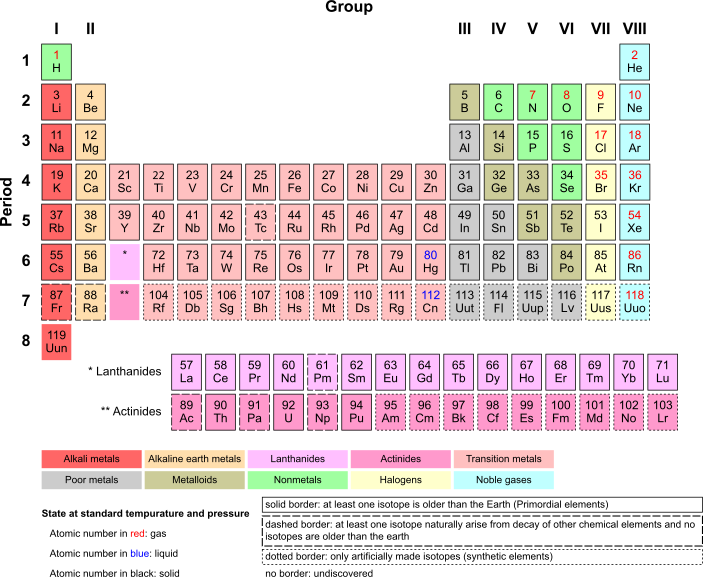
Periodic table of the elements: Group numbers shown past Roman numerals (to a higher place the table) tell us how many valence electrons there are for each chemical element.
Some periodic tables list the group numbers in Arabic numbers instead of Roman numerals. In that case, the transition metal groups are included in the counting and the groups indicated at the top of the periodic table have numbers 1, 2, thirteen, 14, 15, 16, 17, 18. The corresponding roman numerals used are I, II, III, IV, V, VI, VII, 8.
Survey of the Groups in the Periodic Tabular array
Take the first column or group of the periodic tabular array (labeled 'I'): hydrogen (H), lithium (Li), sodium (Na), potassium (G), etc. Each of these elements has one valence electron. The second column or grouping (labeled 'II') means that beryllium (Be), magnesium (Mg), calcium (Ca), etc., all have 2 valence electrons.
The middle office of the periodic table that contains the transition metals is skipped in this procedure for reasons having to do with the electronic configuration of these elements.
Proceeding to the column labeled 'Iii', we find that those elements (B, Al, Ga, In,…) have three valence electrons in their outermost or valence level.
We can go on this inspection of the groups until we attain the eighth and final column, in which the most stable elements are listed. These are all gaseous under normal atmospheric condition of temperature and pressure, and are chosen 'noble gases.' Neon (Ne), argon (Ar), krypton (Kr), etc., each contain eight electrons in their valence level. Therefore, these elements have a full valence level that has the maximum number of electrons possible. Helium (He), at the very top of this column is an exception considering information technology has 2 valence electrons; its valence level is the start master energy level which tin simply have two electrons, so it has the maximum number of electrons in its valence level as well.

The Lewis symbol for helium: Helium is ane of the noble gases and contains a full valence vanquish. Unlike the other noble gases in Group 8, Helium only contains two valence electrons. In the Lewis symbol, the electrons are depicted as ii solitary pair dots.
The noble gases represent elements of such stability that they are not chemically reactive, so they can be called inert. In other words, they don't need to bond with any other elements in order to achieve a lower energy configuration. We explicate this miracle by attributing their stability to having a 'full' valence level.
The significance in understanding the nature of the stability of noble gases is that it guides united states of america in predicting how other elements will react in society to achieve the same electronic configuration as the noble gases by having a full valence level.
Writing Lewis Symbols for Atoms
Lewis symbols for the elements depict the number of valence electrons equally dots. In accordance with what we discussed above, here are the Lewis symbols for the first twenty elements in the periodic table. The heavier elements volition follow the same trends depending on their group.
Once you can describe a Lewis symbol for an cantlet, you can employ the knowledge of Lewis symbols to create Lewis structures for molecules.
Introduction to Lewis Structures for Covalent Molecules
In covalent molecules, atoms share pairs of electrons in club to attain a full valence level.
Learning Objectives
Predict and draw the Lewis structure of elementary covalent molecules and compounds
Key Takeaways
Cardinal Points
- The octet rule says that the noble gas electronic configuration is a specially favorable one that can exist accomplished through formation of electron pair bonds between atoms.
- In many atoms, not all of the electron pairs comprising the octet are shared between atoms. These unshared, non-bonding electrons are called ' lone pairs ' of electrons.
- Although lone pairs are not directly involved in bond formation, they should always be shown in Lewis structures.
- There is a logical procedure that can be followed to draw the Lewis structure of a molecule or compound.
Cardinal Terms
- octet dominion: Atoms endeavour to achieve the electronic configuration of the noble gas nearest to them in the periodic table by achieving a full valence level with eight electrons.
- exceptions to the octet rule: Hydrogen (H) and helium (He) merely need two electrons to have a full valence level.
- covalent bond: Two atoms share valence electrons in order to achieve a element of group 0 electronic configuration.
- Lewis structure: Formalism used to show the structure of a molecule or compound, in which shared electrons pairs between atoms are indicated by dashes. Non-bonding, lone pairs of electrons must also be shown.
The Octet Rule
Noble gases like He, Ne, Ar, Kr, etc., are stable because their valence level is filled with as many electrons as possible. Eight electrons fill the valence level for all noble gases, except helium, which has two electrons in its total valence level. Other elements in the periodic table react to form bonds in which valence electrons are exchanged or shared in order to achieve a valence level which is filled, just like in the noble gases. Nosotros refer to this chemical tendency of atoms as 'the octet rule,' and it guides us in predicting how atoms combine to form molecules and compounds.
Covalent Bonds and Lewis Diagrams of Simple Molecules
The simplest example to consider is hydrogen (H), which is the smallest element in the periodic table with 1 proton and one electron. Hydrogen can become stable if information technology achieves a full valence level like the noble gas that is closest to it in the periodic table, helium (He). These are exceptions to the octet dominion because they only crave two electrons to accept a full valence level.
Two H atoms tin can come together and share each of their electrons to create a ' covalent bond.' The shared pair of electrons can be thought of equally belonging to either cantlet, and thus each atom at present has two electrons in its valence level, like He. The molecule that results is H2, and it is the almost abundant molecule in the universe.

Lewis structure of diatomic hydrogen: This is the process through which the H2 molecule is formed. Two H atoms, each contributing an electron, share a pair of electrons. This is known as a 'single covalent bond.' Discover how the two electrons can be found in a region of space between the two atomic nuclei.
The Lewis formalism used for the H2 molecule is H:H or H—H. The former, known as a 'Lewis dot diagram,' indicates a pair of shared electrons betwixt the atomic symbols, while the latter, known as a 'Lewis structure,' uses a dash to signal the pair of shared electrons that form a covalent bail. More complicated molecules are depicted this way as well.

Lewis dot dragram for methane: Methane, with molecular formula CH4, is shown. The electrons are color-coded to indicate which atoms they belonged to before the covalent bonds formed, with red representing hydrogen and blueish representing carbon. Four covalent bonds are formed so that C has an octet of valence electrons, and each H has ii valence electrons—one from the carbon atom and i from i of the hydrogen atoms.
Now consider the example of fluorine (F), which is constitute in grouping 7 (or 17) of the periodic table. Information technology therefore has seven valence electrons and only needs one more in lodge to accept an octet. One manner that this can happen is if two F atoms make a bond, in which each atom provides one electron that can be shared betwixt the ii atoms. The resulting molecule that is formed is Fii, and its Lewis structure is F—F.
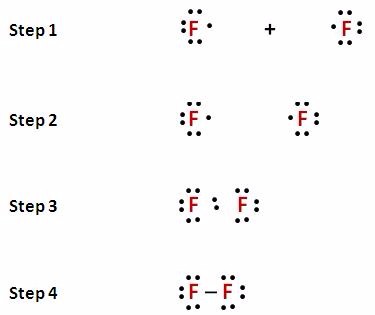
Achieving an octet of valence electrons: Ii fluorine atoms are able to share an electron pair, which becomes a covalent bond. Notice that just the outer (valence level) electrons are involved, and that in each F atom, 6 valence electrons exercise not participate in bonding. These are 'lone pairs' of electrons.
Afterwards a bond has formed, each F cantlet has 6 electrons in its valence level which are not used to class a bond. These not-bonding valence electrons are chosen 'solitary pairs' of electrons and should e'er be indicated in Lewis diagrams.

Lewis construction of acetic acid: Acetic acid, CH3COOH, can be written out with dots indicating the shared electrons, or, preferably, with dashes representing covalent bonds. Discover the alone pairs of electrons on the oxygen atoms are still shown. The methyl group carbon atom has six valence electrons from its bonds to the hydrogen atoms considering carbon is more electronegative than hydrogen. Too, one electron is gained from its bond with the other carbon atom because the electron pair in the C−C bail is split equally.
Procedure for Drawing Simple Lewis Structures
We have looked at how to make up one's mind Lewis structures for elementary molecules. The procedure is as follows:
- Write a structural diagram of the molecule to clearly show which atom is connected to which (although many possibilities exist, nosotros usually pick the element with the nearly number of possible bonds to exist the central atom).
- Describe Lewis symbols of the individual atoms in the molecule.
- Bring the atoms together in a manner that places eight electrons around each cantlet (or two electrons for H, hydrogen) wherever possible.
- Each pair of shared electrons is a covalent bond which can be represented by a dash.

Alternate view of lewis dot construction of h2o: This system of shared electrons betwixt O and H results in the oxygen atom having an octet of electrons, and each H atom having two valence electrons.
Multiple bonds can too course between elements when 2 or 3 pairs of electrons are shared to produce double or triple bonds, respectively. The Lewis structure for carbon dioxide, CO2, is a good case of this.

Lewis structure of carbon dioxide: This figure explains the bonding in a CO2 molecule. Each O atom starts out with half dozen (red) electrons and C with four (black) electrons, and each bail behind an O cantlet and the C cantlet consists of two electrons from the O and two of the four electrons from the C.
In order to achieve an octet for all three atoms in COtwo, 2 pairs of electrons must be shared between the carbon and each oxygen. Since four electrons are involved in each bail, a double covalent bond is formed. You can see that this is how the octet rule is satisfied for all atoms in this case. When a double bond is formed, you even so need to show all electrons, so double dashes between the atoms testify that four electrons are shared.

Final Lewis structure for carbon dioxide: Covalent bonds are indicated every bit dashes and alone pairs of electrons are shown as pairs of dots. in carbon dioxide, each oxygen atom has 2 lone pairs of electrons remaining; the covalent bonds between the oxygen and carbon atoms each use two electrons from the oxygen atom and 2 from the carbon.
Lewis Structures for Polyatomic Ions
The Lewis structure of an ion is placed in brackets and its accuse is written as a superscript exterior of the brackets, on the upper right.
Learning Objectives
Apply the rules for drawing Lewis structures to polyatomic ions
Cardinal Takeaways
Cardinal Points
- Ions are treated virtually the same way as a molecule with no accuse. Nonetheless, the number of electrons must exist adapted to business relationship for the net electrical charge of the ion.
- When counting electrons, negative ions should have extra electrons placed in their Lewis structures, while positive ions should have fewer electrons than an uncharged molecule.
Key Terms
- polyatomic ion: A charged species composed of two or more atoms covalently bonded, or of a metallic circuitous that acts as a unmarried unit in acid-base chemical science or in the germination of salts. Also known every bit a molecular ion.
The full number of electrons represented in a Lewis structure is equal to the sum of the numbers of valence electrons in each private cantlet. Non-valence electrons are not represented in Lewis structures. Later on the full number of available electrons has been determined, electrons must exist placed into the structure.
Lewis structures for polyatomic ions are drawn by the aforementioned methods that nosotros accept already learned. When counting electrons, negative ions should have actress electrons placed in their Lewis structures; positive ions should have fewer electrons than an uncharged molecule. When the Lewis construction of an ion is written, the unabridged structure is placed in brackets, and the charge is written as a superscript on the upper right, exterior of the brackets. For example, consider the ammonium ion, NH4 +, which contains 9 (v from North and 1 from each of the iv H atoms) –one = eight electrons. One electron is subtracted because the unabridged molecule has a +1 charge.

Coordinate covalent bonding: The ammonium ion, NH4+, contains nine–i = eight electrons.
Negative ions follow the same procedure. The chlorite ion, ClO2 –, contains 19 (vii from the Cl and 6 from each of the 2 O atoms) +1 = 20 electrons. I electron is added because the entire molecule has a -1 charge.
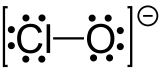
Hypochlorite ion Lewis structure: The hypochlorite ion, ClO−, contains xiii + 1 = xiv electrons.

Source: https://courses.lumenlearning.com/boundless-chemistry/chapter/lewis-dot-symbols-and-lewis-structures/
Posted by: proutopeashom96.blogspot.com
0 Response to "When Drawing Lewis Structures, Which Atoms Must Receive Lone Pairs First?"
Post a Comment