

Which Describes The Makeup Of Volcanic Ash?


Volcanic ash deposits on a parked McDonnell-Douglas DC-x-thirty during the 1991 eruption of Mount Pinatubo, causing the shipping to remainder on its tail. While falling ash behaves in a similar way to snow, the sheer weight of deposits tin can crusade serious harm to buildings and vehicles, every bit seen hither, where the deposits were able to cause the 120 ton airliner'southward center of gravity to shift.

Volcanic ash consists of fragments of rock, mineral crystals, and volcanic glass, created during volcanic eruptions and measuring less than 2 mm (0.079 inches) in diameter.[i] The term volcanic ash is also often loosely used to refer to all explosive eruption products (correctly referred to as tephra), including particles larger than 2 mm. Volcanic ash is formed during explosive volcanic eruptions when dissolved gases in magma aggrandize and escape violently into the temper. The force of the gases shatters the magma and propels information technology into the atmosphere where it solidifies into fragments of volcanic stone and glass. Ash is also produced when magma comes into contact with water during phreatomagmatic eruptions, causing the water to explosively flash to steam leading to shattering of magma. Once in the air, ash is transported by air current upwards to thousands of kilometres away.
Due to its wide dispersal, ash can take a number of impacts on gild, including animate being and human health, disruption to aviation, disruption to critical infrastructure (e.1000., electrical power supply systems, telecommunication, water and waste-water networks, transportation), primary industries (eastward.g., agriculture), buildings and structures.
Formation [edit]

Volcanic ash is formed during explosive volcanic eruptions and phreatomagmatic eruptions,[2] and may also be formed during transport in pyroclastic density currents.[three]
Explosive eruptions occur when magma decompresses equally it rises, allowing dissolved volatiles (dominantly water and carbon dioxide) to exsolve into gas bubbling.[4] As more bubbles nucleate a foam is produced, which decreases the density of the magma, accelerating it up the conduit. Fragmentation occurs when bubbling occupy ~70–eighty vol% of the erupting mixture.[five] When fragmentation occurs, violently expanding bubbling tear the magma apart into fragments which are ejected into the temper where they solidify into ash particles. Fragmentation is a very efficient process of ash formation and is capable of generating very fine ash even without the improver of water.[6]
Volcanic ash is besides produced during phreatomagmatic eruptions. During these eruptions fragmentation occurs when magma comes into contact with bodies of water (such as the sea, lakes and marshes) groundwater, snow or ice. As the magma, which is significantly hotter than the boiling point of water, comes into contact with water an insulating vapor motion-picture show forms (Leidenfrost issue).[7] Eventually this vapor film volition plummet leading to direct coupling of the cold water and hot magma. This increases the estrus transfer which leads to the rapid expansion of water and fragmentation of the magma into pocket-size particles which are subsequently ejected from the volcanic vent. Fragmentation causes an increase in contact area betwixt magma and h2o creating a feedback mechanism,[7] leading to farther fragmentation and production of fine ash particles.
Pyroclastic density currents tin also produce ash particles. These are typically produced by lava dome collapse or collapse of the eruption column.[8] Within pyroclastic density currents particle chafe occurs every bit particles interact with each other resulting in a reduction in grain size and production of fine grained ash particles. In addition, ash can be produced during secondary fragmentation of pumice fragments, due to the conservation of oestrus inside the flow.[9] These processes produce large quantities of very fine grained ash which is removed from pyroclastic density currents in co-ignimbrite ash plumes.
Concrete and chemical characteristics of volcanic ash are primarily controlled by the style of volcanic eruption.[x] Volcanoes display a range of eruption styles which are controlled past magma chemistry, crystal content, temperature and dissolved gases of the erupting magma and can be classified using the volcanic explosivity index (VEI). Effusive eruptions (VEI one) of basaltic composition produce <105 mthree of ejecta, whereas extremely explosive eruptions (VEI 5+) of rhyolitic and dacitic composition can inject big quantities (>x9 mthree) of ejecta into the atmosphere.[11]
Backdrop [edit]
Chemic [edit]
The types of minerals nowadays in volcanic ash are dependent on the chemical science of the magma from which it erupted. Because that the most abundant elements found in silicate magma are silicon and oxygen, the various types of magma (and therefore ash) produced during volcanic eruptions are most commonly explained in terms of their silica content. Depression energy eruptions of basalt produce a characteristically dark coloured ash containing ~45–55% silica that is mostly rich in atomic number 26 (Fe) and magnesium (Mg). The virtually explosive rhyolite eruptions produce a felsic ash that is high in silica (>69%) while other types of ash with an intermediate composition (e.k., andesite or dacite) have a silica content between 55–69%.
The principal gases released during volcanic activity are water, carbon dioxide, hydrogen, sulfur dioxide, hydrogen sulfide, carbon monoxide and hydrogen chloride.[12] The sulfur and halogen gases and metals are removed from the atmosphere past processes of chemical reaction, dry out and moisture deposition, and by adsorption onto the surface of volcanic ash.
It has long been recognised that a range of sulfate and halide (primarily chloride and fluoride) compounds are readily mobilised from fresh volcanic ash.[thirteen] [fourteen] Information technology is considered virtually likely that these salts are formed as a effect of rapid acid dissolution of ash particles within eruption plumes, which is thought to supply the cations involved in the deposition of sulfate and halide salts.[15]
While some 55 ionic species have been reported in fresh ash leachates,[12] the almost abundant species unremarkably institute are the cations Na+, K+, Ca2+ and Mgtwo+ and the anions Cl−, F− and SO4 2−.[12] [14] Molar ratios between ions nowadays in leachates suggest that in many cases these elements are present as simple salts such as NaCl and CaSOfour.[12] [16] [17] [18] In a sequential leaching experiment on ash from the 1980 eruption of Mount St. Helens, chloride salts were found to exist the most readily soluble, followed by sulfate salts[sixteen] Fluoride compounds are in full general simply sparingly soluble (e.chiliad., CaF2, MgF2), with the exception of fluoride salts of brine metals and compounds such as calcium hexafluorosilicate (CaSiFsix).[19] The pH of fresh ash leachates is highly variable, depending on the presence of an acidic gas condensate (primarily as a result of the gases SO2, HCl and HF in the eruption feather) on the ash surface.
The crystalline-solid structure of the salts human activity more as an insulator than a usher.[20] [21] [22] [23] However, once the salts are dissolved into a solution by a source of moisture (e.g., fog, mist, light rain, etc.), the ash may become corrosive and electrically conductive. A recent study has shown that the conductivity of volcanic ash increases with (ane) increasing moisture content, (2) increasing soluble common salt content, and (three) increasing compaction (bulk density).[23] The power of volcanic ash to deport current has significant implications for electric ability supply systems.
Physical [edit]
Components [edit]
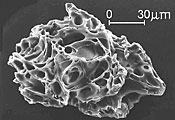
Volcanic ash particles erupted during magmatic eruptions are made up of various fractions of vitric (burnished, not-crystalline), crystalline or lithic (non-magmatic) particles. Ash produced during depression viscosity magmatic eruptions (east.g., Hawaiian and Strombolian basaltic eruptions) produce a range of different pyroclasts dependent on the eruptive process. For example, ash nerveless from Hawaiian lava fountains consists of sideromelane (light brown basaltic glass) pyroclasts which contain microlites (modest quench crystals, not to be dislocated with the rare mineral microlite) and phenocrysts. Slightly more mucilaginous eruptions of basalt (east.g., Strombolian) grade a variety of pyroclasts from irregular sideromelane droplets to blocky tachylite (black to dark brown microcrystalline pyroclasts). In contrast, nigh high-silica ash (e.k. rhyolite) consists of pulverised products of pumice (vitric shards), individual phenocrysts (crystal fraction) and some lithic fragments (xenoliths).[24]
Ash generated during phreatic eruptions primarily consists of hydrothermally contradistinct lithic and mineral fragments, usually in a dirt matrix. Particle surfaces are often coated with aggregates of zeolite crystals or clay and only relict textures remain to place pyroclast types.[24]
Morphology [edit]
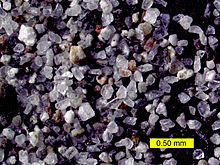
Light microscope image of ash from the 1980 eruption of Mountain St. Helens, Washington
The morphology (shape) of volcanic ash is controlled by a plethora of different eruption and kinematic processes.[24] [25] Eruptions of low-viscosity magmas (e.g., basalt) typically course droplet shaped particles. This droplet shape is, in part, controlled by surface tension, acceleration of the droplets subsequently they get out the vent, and air friction. Shapes range from perfect spheres to a variety of twisted, elongate droplets with smoothen, fluidal surfaces.[25]
The morphology of ash from eruptions of high-viscosity magmas (east.g., rhyolite, dacite, and some andesites) is generally dependent on the shape of vesicles in the ascent magma before disintegration. Vesicles are formed past the expansion of magmatic gas before the magma has solidified. Ash particles can have varying degrees of vesicularity and vesicular particles tin can have extremely high surface surface area to volume ratios.[24] Concavities, troughs, and tubes observed on grain surfaces are the result of cleaved vesicle walls.[25] Vitric ash particles from high-viscosity magma eruptions are typically angular, vesicular pumiceous fragments or sparse vesicle-wall fragments while lithic fragments in volcanic ash are typically equant, or athwart to subrounded. Lithic morphology in ash is generally controlled by the mechanical properties of the wall rock broken up past spalling or explosive expansion of gases in the magma equally it reaches the surface.
The morphology of ash particles from phreatomagmatic eruptions is controlled by stresses within the chilled magma which event in fragmentation of the glass to class modest blocky or pyramidal glass ash particles.[24] Vesicle shape and density play simply a minor role in the determination of grain shape in phreatomagmatic eruptions. In this sort of eruption, the rising magma is quickly cooled on contact with basis or surface water. Stresses within the "quenched" magma cause fragmentation into five dominant pyroclast shape-types: (1) blocky and equant; (ii) vesicular and irregular with smoothen surfaces; (3) moss-like and convoluted; (4) spherical or drib-like; and (five) plate-like.
Density [edit]
The density of individual particles varies with dissimilar eruptions. The density of volcanic ash varies betwixt 700–1200 kg/chiliad3 for pumice, 2350–2450 kg/mthree for glass shards, 2700–3300 kg/g3 for crystals, and 2600–3200 kg/chiliad3 for lithic particles.[26] Since coarser and denser particles are deposited close to source, fine drinking glass and pumice shards are relatively enriched in ash fall deposits at distal locations.[27] The high density and hardness (~v on the Mohs Hardness Scale) together with a high degree of angularity, make some types of volcanic ash (particularly those with a loftier silica content) very abrasive.
Grain size [edit]
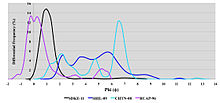
Volcanic ash grain size distributions from four volcanic eruptions
Volcanic ash consists of particles (pyroclasts) with diameters <2 mm (particles >two mm are classified equally lapilli),[ane] and tin can be as fine as 1 μm.[10] The overall grain size distribution of ash can vary greatly with different magma compositions. Few attempts accept been made to correlate the grain size characteristics of a deposit with those of the outcome which produced it, though some predictions tin be made. Rhyolitic magmas generally produce finer grained material compared to basaltic magmas, due to the higher viscosity and therefore explosivity. The proportions of fine ash are higher for silicic explosive eruptions, probably because vesicle size in the pre-eruptive magma is smaller than those in mafic magmas.[1] At that place is good evidence that pyroclastic flows produce loftier proportions of fine ash by communition and information technology is likely that this process also occurs within volcanic conduits and would be most efficient when the magma fragmentation surface is well below the summit crater.[1]
Dispersal [edit]
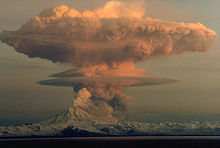
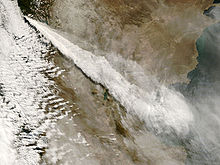
Ash plume rising from Mountain Redoubt after an eruption on April 21, 1990
Ash particles are incorporated into eruption columns as they are ejected from the vent at high velocity. The initial momentum from the eruption propels the column up. As air is drawn into the column, the bulk density decreases and information technology starts to rise buoyantly into the temper.[8] At a point where the majority density of the column is the aforementioned every bit the surrounding atmosphere, the column volition finish ascent and start moving laterally. Lateral dispersion is controlled by prevailing winds and the ash may be deposited hundreds to thousands of kilometres from the volcano, depending on eruption column meridian, particle size of the ash and climatic weather (especially current of air direction and forcefulness and humidity).[28]

Ash fallout occurs immediately after the eruption and is controlled by particle density. Initially, fibroid particles fall out shut to source. This is followed by fallout of accretionary lapilli, which is the result of particle agglomeration within the cavalcade.[29] Ash fallout is less concentrated during the terminal stages every bit the column moves downwind. This results in an ash fall deposit which generally decreases in thickness and grain size exponentially with increasing distance from the volcano.[xxx] Fine ash particles may remain in the atmosphere for days to weeks and be dispersed past high-altitude winds. These particles can impact on the aviation industry (refer to impacts section) and, combined with gas particles, can impact global climate.
Volcanic ash plumes can form above pyroclastic density currents, these are called co-ignimbrite plumes. As pyroclastic density currents travel away from the volcano, smaller particles are removed from the menstruum by elutriation and class a less dense zone overlying the primary menses. This zone then entrains the surrounding air and a buoyant co-ignimbrite plume is formed. These plumes tend to take higher concentrations of fine ash particles compared to magmatic eruption plumes due to the abrasion within the pyroclastic density current.[i]
Impacts [edit]
Population growth has caused the progressive encroachment of urban development into higher risk areas, closer to volcanic centres, increasing the human exposure to volcanic ash fall events.[31]
Direct wellness furnishings of volcanic ash on humans are usually short-term and mild for persons in normal health, though prolonged exposure potentially poses some gamble of silicosis in unprotected workers.[32] Of greater concern is the impact of volcanic ash on the infrastructure critical to supporting modern societies, particularly in urban areas, where high population densities create loftier demand for services.[33] [31] Several recent eruptions take illustrated the vulnerability of urban areas that received but a few millimetres or centimetres of volcanic ash.[34] [35] [36] [37] [38] This has been sufficient to crusade disruption of transportation,[39] electricity,[xl] water,[41] [42] sewage and storm h2o systems.[43] Costs take been incurred from business disruption, replacement of damaged parts and insured losses. Ash fall impacts on critical infrastructure can too cause multiple knock-on effects, which may disrupt many different sectors and services.[44]
Volcanic ash fall is physically, socially, and economically disruptive.[45] Volcanic ash tin affect both proximal areas and areas many hundreds of kilometres from the source,[46] and causes disruptions and losses in a wide multifariousness of different infrastructure sectors. Impacts are dependent on: ash fall thickness; the grain size and chemistry of the ash; whether the ash is wet or dry out; the elapsing of the ash fall; and any preparedness, management and prevention (mitigation) measures employed to reduce effects from the ash fall. Different sectors of infrastructure and society are affected in different ways and are vulnerable to a range of impacts or consequences. These are discussed in the post-obit sections.[31]
Human and animal wellness [edit]
Ash particles of less than 10 µm bore suspended in the air are known to exist inhalable, and people exposed to ash falls have experienced respiratory discomfort, breathing difficulty, middle and skin irritation, and nose and throat symptoms.[47] Almost of these effects are short-term and are not considered to pose a pregnant health risk to those without pre-existing respiratory conditions.[32] The health effects of volcanic ash depend on the grain size, mineralogical composition and chemical coatings on the surface of the ash particles.[32] Additional factors related to potential respiratory symptoms are the frequency and duration of exposure, the concentration of ash in the air and the respirable ash fraction; the proportion of ash with less than ten µm diameter, known as PM10. The social context may too exist important.
Chronic wellness effects from volcanic ash fall are possible, equally exposure to gratis crystalline silica is known to cause silicosis. Minerals associated with this include quartz, cristobalite and tridymite, which may all be present in volcanic ash. These minerals are described as 'free' silica as the SiO2 is not attached to another element to create a new mineral. Still, magmas containing less than 58% SiO2 are thought to be unlikely to incorporate crystalline silica.[32]
The exposure levels to free crystalline silica in the ash are ordinarily used to characterise the chance of silicosis in occupational studies (for people who work in mining, structure and other industries,) because information technology is classified every bit a human carcinogen by the International Agency for Research on Cancer. Guideline values have been created for exposure, but with unclear rationale; UK guidelines for particulates in air (PM10) are 50 µg/one thousandiii and USA guidelines for exposure to crystalline silica are l µg/g3.[32] Information technology is idea that the guidelines on exposure levels could exist exceeded for short periods of time without significant health effects on the general population.[47]
At that place accept been no documented cases of silicosis developed from exposure to volcanic ash. However, long-term studies necessary to evaluate these effects are defective.[32]
Ingesting ash [edit]
For surface water sources such equally lakes and reservoirs, the volume bachelor for dilution of ionic species leached from ash is generally big. The most abundant components of ash leachates (Ca, Na, Mg, K, Cl, F and And soiv) occur naturally at significant concentrations in about surface waters and therefore are not affected profoundly by inputs from volcanic ashfall, and are likewise of low concern in drinking water, with the exception of fluorine. The elements iron, manganese and aluminium are unremarkably enriched over groundwork levels by volcanic ashfall. These elements may impart a metallic gustatory modality to water, and may produce cherry-red, chocolate-brown or black staining of whiteware, only are not considered a health risk. Volcanic ashfalls are non known to have acquired bug in water supplies for toxic trace elements such equally mercury (Hg) and atomic number 82 (Pb) which occur at very low levels in ash leachates.[42]
Ingesting ash may be harmful to livestock, causing chafe of the teeth, and in cases of high fluorine content, fluorine poisoning (toxic at levels of >100 µg/1000) for grazing animals.[48] It is known from the 1783 eruption of Laki in Iceland that fluorine poisoning occurred in humans and livestock as a outcome of the chemistry of the ash and gas, which contained high levels of hydrogen fluoride. Following the 1995/96 Mount Ruapehu eruptions in New Zealand, two thousand ewes and lambs died after being afflicted past fluorosis while grazing on land with only 1–iii mm of ash fall.[48] Symptoms of fluorosis amongst cattle exposed to ash include chocolate-brown-yellow to green-black mottles in the teeth, and hypersensibility to pressure in the legs and back.[49] Ash ingestion may too cause gastrointestinal blockages.[37] Sheep that ingested ash from the 1991 Mount Hudson volcanic eruption in Chile, suffered from diarrhoea and weakness.
Other furnishings on livestock [edit]
Ash accumulating in the dorsum wool of sheep may add meaning weight, leading to fatigue and sheep that can not stand upwardly. Rainfall may effect in a significant burden as it adds weight to ash.[50] Pieces of wool may autumn away and whatever remaining wool on sheep may be worthless as poor diet associated with volcanic eruptions impacts the quality of the fibre.[50] As the usual pastures and plants get covered in volcanic ash during eruption some livestock may resort to eat whatever is available including toxic plants.[51] There are reports of goats and sheep in Republic of chile and Argentine republic having natural abortions in connectedness to volcanic eruptions.[52]
Infrastructure [edit]
Electricity [edit]
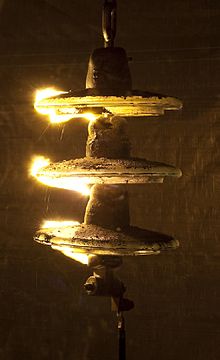
Electrical insulator flashover caused past volcanic ash contamination
Volcanic ash can disrupt electric power supply systems at all levels of ability generation, transformation, manual, and distribution. At that place are four main impacts arising from ash-contamination of apparatus used in the power commitment process:[53]
- Moisture deposits of ash on high voltage insulators tin can initiate a leakage electric current (modest amount of electric current menstruum across the insulator surface) which, if sufficient current is accomplished, tin can cause 'flashover' (the unintended electrical discharge around or over the surface of an insulating cloth).
- If the resulting brusk-circuit current is loftier plenty to trip the excursion breaker then disruption of service will occur. Ash-induced flashover across transformer insulation (bushings) can fire, etch or fissure the insulation irreparably and can effect in the disruption of the power supply.[54]
- Volcanic ash can erode, pit, and scour metallic apparatus, particularly moving parts such every bit h2o and current of air turbines and cooling fans on transformers or thermal power plants.[55]
- The high bulk density of some ash deposits can cause line breakage and harm to steel towers and wooden poles due to ash loading. This is almost hazardous when the ash and/or the lines and structures are wet (e.g., past rainfall) and there has been ≥ten mm of ashfall. Fine-grained ash (e.one thousand., <0.five mm bore) adheres to lines and structures nigh readily. Volcanic ash may also load overhanging vegetation, causing it to fall onto lines. Snowfall and ice accumulation on lines and overhanging vegetation further increases the chance of breakage and or plummet of lines and other hardware.[56]
- Controlled outages of vulnerable connection points (e.g., substations) or circuits until ash fall has subsided or for de-energised cleaning of equipment.[57]
Drinking h2o supplies [edit]

Water turbine from the Agoyan hydroelectric plant eroded by volcanic ash laden water
Groundwater-fed systems are resilient to impacts from ashfall, although airborne ash can interfere with the operation of well-head pumps. Electricity outages caused by ashfall can also disrupt electrically powered pumps if there is no backup generation.[58]
The concrete impacts of ashfall can affect the operation of water treatment plants. Ash tin block intake structures, cause severe abrasion harm to pump impellers and overload pump motors.[58] Ash tin can enter filtration systems such as open sand filters both by direct fallout and via intake waters. In well-nigh cases, increased maintenance will be required to manage the effects of an ashfall, simply there volition not exist service interruptions.[59]
The concluding footstep of drinking water treatment is disinfection to ensure that terminal drinking water is free from infectious microorganisms. As suspended particles (turbidity) tin provide a growth substrate for microorganisms and can protect them from disinfection handling, it is extremely important that the h2o treatment procedure achieves a proficient level of removal of suspended particles. Chlorination may have to be increased to ensure acceptable disinfection.[60]
Many households, and some small communities, rely on rainwater for their drinking water supplies. Roof-fed systems are highly vulnerable to contamination past ashfall, as they have a large surface area relative to the storage tank book. In these cases, leaching of chemical contaminants from the ashfall tin can become a health risk and drinking of h2o is non recommended. Prior to an ashfall, downpipes should be disconnected so that water in the tank is protected. A further problem is that the surface coating of fresh volcanic ash tin be acidic. Unlike most surface waters, rainwater mostly has a very low alkalinity (acrid-neutralising capacity) and thus ashfall may acidify tank waters. This may lead to issues with plumbosolvency, whereby the h2o is more ambitious towards materials that information technology comes into contact with. This can be a particular problem if there are lead-head nails or lead flashing used on the roof, and for copper pipes and other metallic plumbing fittings.[61]
During ashfall events, large demands are commonly placed on water resource for cleanup and shortages can result. Shortages compromise central services such as firefighting and tin can lead to a lack of water for hygiene, sanitation and drinking. Municipal authorities need to monitor and manage this water demand carefully, and may need to advise the public to use cleanup methods that do not use water (e.g., cleaning with brooms rather than hoses).[62]
Wastewater handling [edit]
Wastewater networks may sustain damage similar to water supply networks. It is very difficult to exclude ash from the sewerage system. Systems with combined storm water/sewer lines are most at adventure. Ash volition enter sewer lines where there is arrival/infiltration past stormwater through illegal connections (e.g., from roof downpipes), cross connections, effectually manhole covers or through holes and cracks in sewer pipes.[63] [64]
Ash-laden sewage entering a treatment plant is likely to cause failure of mechanical prescreening equipment such as step screens or rotating screens. Ash that penetrates further into the system will settle and reduce the chapters of biological reactors besides as increasing the volume of sludge and irresolute its composition.[64]
Aircraft [edit]
The main damage sustained by shipping flying into a volcanic ash cloud is abrasion to forward-facing surfaces, such as the windshield and leading edges of the wings, and aggregating of ash into surface openings, including engines.[65] Chafe of windshields and landing lights will reduce visibility forcing pilots to rely on their instruments. However, some instruments may provide wrong readings every bit sensors (e.k., pitot tubes) tin can go blocked with ash. Ingestion of ash into engines causes abrasion damage to compressor fan blades. The ash erodes sharp blades in the compressor, reducing its efficiency. The ash melts in the combustion chamber to form molten glass. The ash then solidifies on turbine blades, blocking air menstruum and causing the engine to stall.[66]
The limerick of most ash is such that its melting temperature is within the operating temperature (>1000 °C) of modernistic large jet engines.[67] The degree of impact depends upon the concentration of ash in the feather, the length of time the aircraft spends within the plume and the actions taken by the pilots. Critically, melting of ash, particularly volcanic glass, can effect in aggregating of resolidified ash on turbine nozzle guide vanes, resulting in compressor stall and consummate loss of engine thrust.[68] The standard procedure of the engine control system when information technology detects a possible stall is to increase ability which would exacerbate the problem. It is recommended that pilots reduce engine power and quickly exit the cloud by performing a descending 180° turn.[68] Volcanic gases, which are present inside ash clouds, can too cause harm to engines and acrylic windshields, and can persist in the stratosphere as an almost invisible aerosol for prolonged periods of time.[69]
Occurrence [edit]
In that location are many instances of harm to jet aircraft as a consequence of an ash meet. On 24 June 1982, a British Airways Boeing 747-236B (Flight 9) flew through the ash cloud from the eruption of Mount Galunggung, Indonesia resulting in the failure of all four engines. The plane descended 24,000 feet (vii,300 grand) in 16 minutes before the engines restarted, allowing the aircraft to brand an emergency landing. On 15 December 1989, a KLM Boeing 747-400 (Flight 867) also lost power to all 4 engines after flying into an ash cloud from Mount Redoubt, Alaska. After dropping 14,700 feet (4,500 grand) in iv minutes, the engines were started just 1–2 minutes before impact. Full impairment was US$80 million and it took 3 months' work to repair the aeroplane.[67] In the 1990s, a further US$100 1000000 of impairment was sustained by commercial aircraft (some in the air, others on the basis) as a issue of the 1991 eruption of Mountain Pinatubo in the Philippines.[67]
In April 2010, airspace all over Europe was affected, with many flights cancelled-which was unprecedented-due to the presence of volcanic ash in the upper atmosphere from the eruption of the Icelandic volcano Eyjafjallajökull.[lxx] On 15 Apr 2010, the Finnish Air Forcefulness halted training flights when harm was constitute from volcanic dust ingestion by the engines of one of its Boeing F-18 Hornet fighters.[71] On 22 April 2010, United kingdom of great britain and northern ireland RAF Typhoon training flights were also temporarily suspended after deposits of volcanic ash were found in a jet's engines.[72] In June 2011, there were similar closures of airspace in Republic of chile, Argentina, Brazil, Australia and New Zealand, post-obit the eruption of Puyehue-Cordón Caulle, Chile.[73]
Detection [edit]

Coverage of the ix VAAC around the earth

The Avoid musical instrument mounted on the fuselage of an AIRBUS A340 examination aircraft
Volcanic ash clouds are very difficult to detect from aircraft as no onboard cockpit instruments exist to detect them. Nevertheless, a new system called Airborne Volcanic Object Infrared Detector (AVOID) has recently been adult by Dr Fred Prata[74] while working at CSIRO Australia[75] and the Norwegian Institute for Air Research, which will permit pilots to discover ash plumes up to sixty km (37 mi) ahead and fly safely effectually them.[76] The organisation uses two fast-sampling infrared cameras, mounted on a forrad-facing surface, that are tuned to find volcanic ash. This organisation can detect ash concentrations of <1 mg/m3 to > 50 mg/m3, giving pilots approximately 7–x minutes warning.[76] The camera was tested[77] [78] by the easyJet airline visitor,[79] AIRBUS and Nicarnica Aviation (co-founded past Dr Fred Prata). The results showed the system could piece of work to distances of ~60 km and upwards to x,000 ft [80] but not any college without some significant modifications.
In addition, footing and satellite based imagery, radar, and lidar can be used to detect ash clouds. This data is passed between meteorological agencies, volcanic observatories and airline companies through Volcanic Ash Advisory Centers (VAAC). There is ane VAAC for each of the ix regions of the world. VAACs can upshot advisories describing the electric current and future extent of the ash cloud.[81]
Airport systems [edit]
Volcanic ash not but affects in-flight operations but can affect ground-based aerodrome operations equally well. Pocket-sized accumulations of ash can reduce visibility, create slippery runways and taxiways, infiltrate communication and electrical systems, interrupt footing services, damage buildings and parked aircraft.[82] Ash aggregating of more than a few millimeters requires removal before airports can resume full operations. Ash does non disappear (dissimilar snowfalls) and must be tending of in a way that prevents it from being remobilised past current of air and aircraft.[83]
Country ship [edit]
Ash may disrupt transportation systems over large areas for hours to days, including roads and vehicles, railways and ports and aircraft. Falling ash will reduce the visibility which can make driving hard and dangerous.[26] In addition, fast travelling cars will stir up ash, creating billowing clouds which perpetuate ongoing visibility hazards. Ash accumulations will subtract traction, especially when wet, and cover road markings.[26] Fine-grained ash can infiltrate openings in cars and abrade almost surfaces, especially between moving parts. Air and oil filters will become blocked requiring frequent replacement. Rail transport is less vulnerable, with disruptions mainly caused by reduction in visibility.[26]
Marine transport can besides be impacted by volcanic ash. Ash fall will block air and oil filters and abrade any moving parts if ingested into engines. Navigation will be impacted by a reduction in visibility during ash fall. Vesiculated ash (pumice and scoria) will float on the h2o surface in 'pumice rafts' which can clog water intakes quickly, leading to over heating of machinery.[26]
Communications [edit]
Telecommunications and broadcast networks can be affected by volcanic ash in the following ways: attenuation and reduction of signal forcefulness; damage to equipment; and overloading of network through user demand. Point attenuation due to volcanic ash is non well documented; however, there have been reports of disrupted communications following the 1969 Surtsey eruption and 1991 Mount Pinatubo eruption. Inquiry by the New Zealand-based Auckland Engineering Lifelines Grouping determined theoretically that impacts on telecommunications signals from ash would be limited to low frequency services such as satellite communication.[37] Point interference may also exist caused past lightning, as this is often generated within volcanic eruption plumes.[84]
Telecommunications equipment may become damaged due to direct ash fall. Virtually modern equipment requires constant cooling from air conditioning units. These are susceptible to blockage past ash which reduces their cooling efficiency.[85] Heavy ash falls may cause telecommunication lines, masts, cables, aerials, antennae dishes and towers to collapse due to ash loading. Moist ash may besides crusade accelerated corrosion of metal components.[37]
Reports from recent eruptions propose that the largest disruption to communication networks is overloading due to loftier user demand.[26] This is common of many natural disasters.[86]
Computers [edit]
Computers may exist impacted past volcanic ash, with their functionality and usability decreasing during ashfall, but it is unlikely they will completely fail.[87] The most vulnerable components are the mechanical components, such as cooling fans, cd drives, keyboard, mice and touch pads. These components can become jammed with fine grained ash causing them to end working; however, nigh can exist restored to working order past cleaning with compressed air. Moist ash may crusade electrical brusque circuits inside desktop computers; however, will not affect laptop computers.[87]
Buildings and structures [edit]
Damage to buildings and structures can range from complete or partial roof collapse to less catastrophic impairment of exterior and internal materials. Impacts depend on the thickness of ash, whether it is moisture or dry out, the roof and building design and how much ash gets within a building. The specific weight of ash tin vary significantly and pelting can increase this by fifty–100%.[10] Issues associated with ash loading are similar to that of snow; however, ash is more severe as i) the load from ash is more often than not much greater, ii) ash does not melt and 3) ash can clog and damage gutters, especially afterwards rain autumn. Impacts for ash loading depend on building blueprint and construction, including roof slope, construction materials, roof span and back up system, and age and maintenance of the edifice.[ten] By and large flat roofs are more susceptible to damage and collapse than steeply pitched roofs. Roofs fabricated of smooth materials (sheet metal or drinking glass) are more likely to shed ash than roofs made with rough materials (thatch, cobblestone or wood shingles). Roof collapse tin can atomic number 82 to widespread injuries and deaths and property damage. For example, the collapse of roofs from ash during the fifteen June 1991 Mount Pinatubo eruption killed nearly 300 people.[88]
Environment and agriculture [edit]
Volcanic ash can take a detrimental impact on the environment which can be difficult to predict due to the large variety of environmental atmospheric condition that exist within the ash fall zone. Natural waterways can exist impacted in the same way equally urban water supply networks. Ash volition increase water turbidity which tin reduce the amount of light reaching lower depths, which tin can inhibit growth of submerged aquatic plants and consequently affect species which are dependent on them such equally fish and shellfish.[89] High turbidity can likewise affect the ability of fish gills to blot dissolved oxygen.[90] Acidification will also occur, which volition reduce the pH of the water and affect the creature and flora living in the surroundings. Fluoride contamination will occur if the ash contains high concentrations of fluoride.[91]
Ash accumulation will likewise affect pasture, plants and trees which are part of the horticulture and agriculture industries. Thin ash falls (<twenty mm) may put livestock off eating, and tin can inhibit transpiration and photosynthesis and alter growth. In that location may exist an increase in pasture production due to a mulching effect and slight fertilizing effect, such equally occurred following the 1980 Mount St. Helens and 1995/96 Mt Ruapehu eruptions.[92] [93] Heavier falls will completely bury pastures and soil leading to death of pasture and sterilization of the soil due to oxygen impecuniousness. Constitute survival is dependent on ash thickness, ash chemistry, compaction of ash, amount of rainfall, duration of burial and the length of plant stalks at the fourth dimension of ash fall.[ten]
Young forests (trees <2 years old) are well-nigh at run a risk from ash falls and are likely to be destroyed by ash deposits >100 mm.[94] Ash fall is unlikely to kill mature trees, merely ash loading may intermission large branches during heavy ash falls (>500 mm). Defoliation of trees may also occur, especially if there is a fibroid ash component inside the ash fall.[x]
Land rehabilitation later ash autumn may be possible depending on the ash eolith thickness. Rehabilitation treatment may include: direct seeding of deposit; mixing of eolith with cached soil; scraping of ash deposit from state surface; and application of new topsoil over the ash deposit.[37]
Interdependence [edit]

Interdependency of volcanic ashfall impacts from the Eyjafjallajökull 2010 eruptions
Disquisitional infrastructure and infrastructure services are vital to the functionality of modern society, to provide: medical care, policing, emergency services, and lifelines such as water, wastewater, and power and transportation links. Ofttimes critical facilities themselves are dependent on such lifelines for operability, which makes them vulnerable to both direct impacts from a hazard event and indirect furnishings from lifeline disruption.[95]
The impacts on lifelines may also be inter-dependent. The vulnerability of each lifeline may depend on: the type of hazard, the spatial density of its critical linkages, the dependency on disquisitional linkages, susceptibility to damage and speed of service restoration, state of repair or historic period, and institutional characteristics or buying.[33]
The 2010 eruption of Eyjafjallajokull in Iceland highlighted the impacts of volcanic ash fall in mod society and our dependence on the functionality of infrastructure services. During this event, the airline manufacture suffered business organization break losses of €one.5–two.v billion from the closure of European airspace for half-dozen days in April 2010 and subsequent closures into May 2010.[96] Ash autumn from this event is also known to have caused local crop losses in agricultural industries, losses in the tourism industry, destruction of roads and bridges in Iceland (in combination with glacial melt water), and costs associated with emergency response and clean-upwardly. However, across Europe there were further losses associated with travel disruption, the insurance industry, the postal service, and imports and exports across Europe and worldwide. These consequences demonstrate the interdependency and variety of impacts from a unmarried event.[38]
Preparedness, mitigation and management [edit]

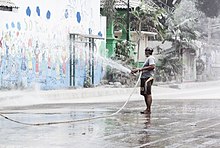
Preparedness for ashfalls should involve sealing buildings, protecting infrastructure and homes, and storing sufficient supplies of food and water to last until the ash fall is over and make clean-upward tin can begin. Dust masks can be worn to reduce inhalation of ash and mitigate against any respiratory wellness affects.[47] Goggles tin be worn to protect against centre irritation.
At habitation, staying informed about volcanic activity, and having contingency plans in identify for alternative shelter locations, constitutes practiced preparedness for an ash fall event. This tin can forbid some impacts associated with ash fall, reduce the effects, and increase the human chapters to cope with such events. A few items such as a flashlight, plastic sheeting to protect electronic equipment from ash ingress, and battery operated radios, are extremely useful during ash fall events.[10]
Communication plans should be made beforehand to inform of mitigation actions being undertaken. Spare parts and back-up systems should be in place prior to ash fall events to reduce service disruption and return functionality as rapidly as possible. Good preparedness also includes the identification of ash disposal sites, before ash fall occurs, to avoid further motion of ash and to aid make clean-up.[97]
Some effective techniques for the management of ash have been adult including cleaning methods and cleaning apparatus, and deportment to mitigate or limit damage. The latter include covering of openings such as: air and h2o intakes, aircraft engines and windows during ash fall events. Roads may be closed to let clean-upward of ash falls, or speed restrictions may be put in identify, in society to prevent motorists from developing motor problems and becoming stranded post-obit an ash autumn.[98] To prevent further effects on undercover water systems or waste material water networks, drains and culverts should be unblocked and ash prevented from inbound the system.[97] Ash can exist moistened (but non saturated) by sprinkling with water, to forbid remobilisation of ash and to help clean-up.[98] Prioritisation of make clean-upwards operations for critical facilities and coordination of clean-upward efforts also establish skillful management exercise.[97] [98] [99]
It is recommended to evacuate livestock in areas where ashfall may reach 5 cm or more.[100]
Volcanic ash soils [edit]
Volcanic ash's principal apply is that of a soil enricher. Once the minerals in ash are washed into the soil by rain or other natural processes, it mixes with the soil to create an andisol layer. This layer is highly rich in nutrients and is very practiced for agricultural utilise; the presence of lush forests on volcanic islands is often as a result of trees growing and flourishing in the phosphorus and nitrogen-rich andisol.[101] Volcanic ash tin too be used as a replacement for sand.[102]
See also [edit]
- Bentonite – Smectite dirt consisting mostly of montmorillonite
- Deposition (aerosol physics)
- Energetically modified cement – Class of cements, mechanically candy to transform reactivity
- NOTAM – Aviation notice alerting aircraft pilots of potential hazards for their flights
- Roman concrete – Building material used in aboriginal Rome
- Tephrochronology – Geochronological technique
References [edit]
- ^ a b c d east Rose, West.I.; Durant, A.J. (2009). "Fine ash content of explosive eruptions". Journal of Volcanology and Geothermal Research. 186 (1–2): 32–39. Bibcode:2009JVGR..186...32R. doi:10.1016/j.jvolgeores.2009.01.010.
- ^ Zimanowski, Bernd; Wohletz, Kenneth; Dellino, Pierfrancesco; Büttner, Ralf (March 2003). "The volcanic ash trouble". Periodical of Volcanology and Geothermal Research. 122 (ane–2): 1–5. Bibcode:2003JVGR..122....1Z. doi:10.1016/S0377-0273(02)00471-vii.
- ^ Dufek, J.; Manga, M. (16 September 2008). "In situ production of ash in pyroclastic flows". Journal of Geophysical Research. 113 (B9): B09207. Bibcode:2008JGRB..113.9207D. doi:10.1029/2007JB005555.
- ^ Wilson, T.M.; Stewart, C. (2012). "Volcanic Ash". In P, Bobrowsky (ed.). Encyclopaedia of Natural Hazards. Springer. p. 1000.
- ^ Cashman, K.V.; Sturtevant, B.; Papale, P.; Navon, O. (2000). "Magmatic fragmentation". In Sigurdsson, H.; Houghton, B.F.; McNutt, S.R.; Rymer, H.; Stix, J. (eds.). Encyclopedia of Volcanoes. San Diego, USA: Elsevier Inc. p. 1417.
- ^ Kueppers, U.; Putz, C.; Spieler, O.; Dingwell, D.B. (2009). "Chafe in pyroclastic density currents: insights from tumbling experiments". Physics and Chemistry of the Earth, Parts A/B/C. 45–46: 33–39. Bibcode:2012PCE....45...33K. doi:10.1016/j.pce.2011.09.002.
- ^ a b Zimanowski, B. (2000). "Physics of phreatomagmatism. Function ane: explosion physics". Terra Nostra. 6: 515–523.
- ^ a b Parfitt, E.A.; Wilson, L. (2008). Fundamentals of Concrete Volcanology. Massachusetts, USA: Blackwell Publishing. p. 256.
- ^ Walker, G.P.Fifty. (1981). "Generation and dispersal of fine ash by volcanic eruptions". Journal of Volcanology and Geothermal Research. xi (1): 81–92. Bibcode:1981JVGR...xi...81W. doi:10.1016/0377-0273(81)90077-ix.
- ^ a b c d e f g USGS. "Volcanic Ash, What it can exercise and how to minimise damage". Retrieved 9 February 2012.
- ^ Newhall, Christopher K.; Self, Stephen (1982). "The Volcanic Explosivity Index (VEI): An Estimate of Explosive Magnitude for Historical Volcanism" (PDF). Journal of Geophysical Enquiry. 87 (C2): 1231–1238. Bibcode:1982JGR....87.1231N. doi:10.1029/JC087iC02p01231. Archived from the original (PDF) on December 13, 2013.
- ^ a b c d Witham, C.Due south.; Oppenheimer, C.; Horwell, C.J. (2005). "Volcanic ash-leachates: a review and recommendations for sampling methods". Journal of Volcanology and Geothermal Research. 141 (iii): 299–326. Bibcode:2011BVol...73..223W. doi:10.1007/s00445-010-0396-1. S2CID 55252456.
- ^ Fruchter, J.S.; Robertson, D.E.; Evans, J.C.; Olsen, M.B.; Lepel, E.A.; et al. (1980). "Mount St. Helens ash from the 18 May 1980 eruption: chemic, concrete, mineralogical, and biological backdrop". Science. 209 (4461): 1116–1125. Bibcode:1980Sci...209.1116F. doi:10.1126/science.209.4461.1116. PMID 17841472. S2CID 22665086.
- ^ a b Jones, M.T.; Gíslason, S.R. (2008). "Rapid releases of metal salts and nutrients following the deposition of volcanic ash into aqueous environments". Geochimica et Cosmochimica Acta. 72 (fifteen): 3661–3680. Bibcode:2008GeCoA..72.3661J. doi:10.1016/j.gca.2008.05.030.
- ^ Delmelle, P.; Lambert, Yard.; Dufrêne, Y.; Gerin, P.; Óskarsson, O. (2007). "Gas/aerosol-ash interaction in volcanic plumes: new insights from surface assay of fine ash particles". Globe and Planetary Science Letters. 259 (ane–2): 159–170. Bibcode:2007E&PSL.259..159D. doi:10.1016/j.epsl.2007.04.052.
- ^ a b Taylor, H.E.; Lichte, F.E. (1980). "Chemical limerick of Mount St. Helens volcanic ash". Geophysical Research Letters. seven (xi): 949–952. Bibcode:1980GeoRL...vii..949T. doi:10.1029/GL007i011p00949.
- ^ Smith, D.B.; Zielinski, R.A.; Taylor, H.E.; Sawyer, M.B. (1983). "Leaching characteristics of ash from the May 18, 1980, eruption of Mountain St. Helens volcano, Washington". Bulletin Volcanologique. 46 (ii): 103–124. Bibcode:1983BVol...46..103S. doi:10.1007/bf02597580. S2CID 134205180.
- ^ Risacher, F.; Alonso, H. (2001). "Geochemistry of ash leachates from the 1993 Lascar eruption, northern Chile. Implication for recycling of ancient evaporites". Journal of Volcanology and Geothermal Research. 109 (4): 319–337. Bibcode:2001JVGR..109..319R. doi:10.1016/S0377-0273(01)00198-6.
- ^ Cronin, S.J.; Abrupt, D.Southward. (2002). "Environmental impacts on health from continuous volcanic activity at Yasur (Tanna) and Ambrym, Vanuatu". Periodical of Environmental Wellness Research. 12 (2): 109–123. doi:ten.1080/09603120220129274. PMID 12396528. S2CID 2939277.
- ^ Nellis, C.A.; Hendrix, K.W. (1980). "Progress report on the investigation of volcanic ash fallout from Mount St Helens". Bonneville Power Administration, Laboratory Report ERJ-fourscore-47.
- ^ Sarkinen, C.F.; Wiitala, J.T. (1981). "Investigation of volcanic ash in manual facilities in the Pacific Northwest". IEEE Transactions on Power Apparatus and Systems. 100 (5): 2278–2286. Bibcode:1981ITPAS.100.2278S. doi:10.1109/TPAS.1981.316741. S2CID 41855034.
- ^ Bebbington, G.; Cronin, S.J.; Chapman, I.; Turner, M.B. (2008). "Quantifying volcanic ash fall hazard to electricity infrastructure". Journal of Volcanology and Geothermal Research. 177 (four): 1055–1062. Bibcode:2008JVGR..177.1055B. doi:ten.1016/j.jvolgeores.2008.07.023.
- ^ a b Wardman, J.B.; Wilson, T.M.; Bodger, P.S.; Cole, J.Westward.; Johnston, D.Chiliad. (2011). "Investigating the electrical electrical conductivity of volcanic ash and its upshot on HV power systems". Physics and Chemistry of the Earth. 45–46: 128–145. Bibcode:2012PCE....45..128W. doi:ten.1016/j.pce.2011.09.003.
- ^ a b c d east Heiken, Grand.; Wohletz, Yard.H. (1985). Volcanic ash. University of California Press. p. 245.
- ^ a b c Heiken, Thousand. (1972). "Morphology and petrography of volcanic ashes". Geological Gild of America Bulletin. 83 (seven): 1961–1988. Bibcode:1972GSAB...83.1961H. doi:ten.1130/0016-7606(1972)83[1961:mapova]2.0.co;2.
- ^ a b c d e f Wilson, T.Yard.; Stewart, C.; Sword-Daniels, V.; Leonard, Yard.; Johnston, D.K.; Cole, J.W.; Wardman, J.; Wilson, K.; Barnard, S. (2011). "Volcanic ash impacts on disquisitional infrastructure". Physics and Chemistry of the Earth. 45–46: 5–23. Bibcode:2012PCE....45....5W. doi:10.1016/j.pce.2011.06.006.
- ^ Shipley, S.; Sarna-Wojcicki, A.M. (1982). "Distribution, thickness, and mass of belatedly pleistocene and holocene tephra from major volcanoes in the northwestern United states: a preliminary assessment of hazards from volcanic ejecta to nuclear reactors in the Pacific Northwest". U.s. Geological Survey Miscellaneous Field Studies Map MF-1435.
- ^ Carey, S.; Sparks, R.S.J. (1986). "Quantitative models of the fallout and dispersal of tephra from volcanic eruption columns". Bulletin of Volcanology. 48 (two–iii): 109–125. Bibcode:1986BVol...48..109C. doi:10.1007/BF01046546. S2CID 128475680.
- ^ Brown, R.J.; Bonadonna, C.; Durant, A.J. (2011). "A review of volcanic ash aggregation" (PDF). Chemistry and Physics of the World. 45–46: 65–78. Bibcode:2012PCE....45...65B. doi:10.1016/j.pce.2011.11.001. S2CID 55127478.
- ^ Pyle, D. (1989). "The thickness, volume and grainsize of tephra fall deposits". Bulletin of Volcanology. 51 (i): one–15. Bibcode:1989BVol...51....1P. doi:ten.1007/BF01086757. S2CID 140635312.
- ^ a b c Wilson, Thomas M.; Stewart, Ballad; Sword-Daniels, Victoria; Leonard, Graham S.; Johnston, David M.; Cole, Jim W.; Wardman, Johnny; Wilson, Grant; Barnard, Scott T. (January 2012). "Volcanic ash impacts on critical infrastructure". Physics and Chemistry of the World, Parts A/B/C. 45–46: v–23. Bibcode:2012PCE....45....5W. doi:x.1016/j.pce.2011.06.006.
- ^ a b c d e f Horwell, C.J.; Baxter, P.J. (2006). "The respiratory health hazards of volcanic ash: a review for volcanic risk mitigation". Bulletin of Volcanology. 69 (1): 1–24. Bibcode:2006BVol...69....1H. doi:ten.1007/s00445-006-0052-y. S2CID 19173052.
- ^ a b Platt, R.H. (1991). "Lifelines; An emergency Management Priority for the United States in the 1990s". Disasters. fifteen (ii): 172–176. doi:10.1111/j.1467-7717.1991.tb00446.x.
- ^ Johnston, D.Yard.; Houghton, B.F.; Neall, 5.E.; Ronan, K.R.; Paton, D. (2000). "Impacts of the 1945 and 1995–1996 Ruapehu eruptions, New Zealand: An example of increasing societal vulnerability". GSA Bulletin. 112 (5): 720–726. Bibcode:2000GSAB..112..720J. doi:10.1130/0016-7606(2000)112<720:iotare>2.0.co;two.
- ^ Leonard, G.S.; Johnston, D.One thousand.; Williams, South.; Cole, J.W.; Finnis, Thou.; Barnard, S. (2005). "Impacts and management of recent volcanic eruptions in Republic of ecuador: lessons for New Zealand". Institute of Geological and Nuclear Sciences Science Report: 51.
- ^ Wilson, T.M.; Cole, J.; Stewart, C.; Dewar, D.; Cronin, S. (2008). "Assessment of long-term impacts on agriculture and infrastructure and recovery from the 1991 eruption of Hudson Volcano, Republic of chile". University of Canterbury: 34.
- ^ a b c d e Wilson, T.1000. (2009). Vulnerability of Pastoral Farming Systems to Volcanic Ash fall Hazard. doi:ten.26021/9258.
- ^ a b Sword-Daniels, V.L. (2010). The impacts of volcanic ash autumn on disquisitional infrastructure systems.
- ^ Casadevall, T.J., ed. (1994). Volcanic ash and aviation prophylactic: proceedings of the offset international symposium on volcanic ash and aviation safety (No. 2047). United states of america Government Press Office. Retrieved 6 December 2021.
- ^ Bebbington, Mark; Cronin, Shane J.; Chapman, Ian; Turner, Michael B. (November 2008). "Quantifying volcanic ash autumn risk to electricity infrastructure". Periodical of Volcanology and Geothermal Research. 177 (four): 1055–1062. Bibcode:2008JVGR..177.1055B. doi:10.1016/j.jvolgeores.2008.07.023.
- ^ Johnston, D.Thou.; Stewart, C.; Leonard, G.S.; Hoverd, J.; Thordarsson, T.; Cronin, Due south. (2004). "Impacts of volcanic ash on h2o supplies in Auckland: part I". Establish of Geological and Nuclear Sciences Science Report: 25.
- ^ a b Stewart, C.; Johnston, D.K.; Leonard, G.S.; Horwell, C.J.; Thordarson, T.; Cronin, S.J. (2006). "Contamination of water supplies by volcanic ash fall: A literature review and simple affect modelling". Periodical of Volcanology and Geothermal Research. 158 (iii–4): 296–306. Bibcode:2006JVGR..158..296S. doi:ten.1016/j.jvolgeores.2006.07.002.
- ^ Wilson et al., "4.i. Impacts on sewerage and stormwater drainage networks". sfn fault: no target: CITEREFWilsonStewartSword-DanielsLeonard (assist)
- ^ Wilson et al., "eight.2. Case study in infrastructure interdependency: Montserrat". sfn error: no target: CITEREFWilsonStewartSword-DanielsLeonard (aid)
- ^ Stohl, A.; Prata, A. J.; Eckhardt, Due south.; Clarisse, L.; Durant, A.; Henne, Southward.; Kristiansen, N. I.; Minikin, A.; Schumann, U.; Seibert, P.; Stebel, K.; Thomas, H. Eastward.; Thorsteinsson, T.; Tørseth, K.; Weinzierl, B. (eleven May 2011). "Decision of time- and top-resolved volcanic ash emissions and their use for quantitative ash dispersion modeling: the 2010 Eyjafjallajökull eruption". Atmospheric Chemical science and Physics. xi (9): 4333–4351. Bibcode:2011ACP....11.4333S. doi:ten.5194/acp-11-4333-2011.
- ^ Wilson et al., "1.4. Distribution". sfn mistake: no target: CITEREFWilsonStewartSword-DanielsLeonard (help)
- ^ a b c International Volcanic Health Chance Network. "International Volcanic Health Hazard Network". Retrieved xxx November 2011.
- ^ a b Cronin, Southward.J.; Neall, 5.East.; Lecointre, J.A.; Hedley, M.J.; Loganathan, P. (2003). "Environmental hazards of fluoride in volcanic ash: a case study from Ruapehu Volcano, New Zealand". Journal of Volcanology and Geothermal Research. 121 (3–4): 271–291. Bibcode:2003JVGR..121..271C. doi:10.1016/S0377-0273(02)00465-1.
- ^ Araya Valenzuela, Oscar (2015). Erupciones volcánicas: Efectos sobre la ganadería. Collección Austral Universitaria de Ciencias Silvoagropecuarias (in Spanish). Ediciones UACh. p. seventy. ISBN978-956-9412-20-2.
- ^ a b Araya Valenzuela 2015, p. 63.
- ^ Araya Valenzuela 2015, p. 77.
- ^ Araya Valenzuela 2015, p. 76.
- ^ Wilson, T.Chiliad.; Daly, G.; Johnston, D.M. (2009). "Review of Impacts of Volcanic Ash on Electricity Distribution Systems, Dissemination and Communication Networks". Auckland Technology Lifelines Grouping Project AELG-19. Auckland Regional Council Technical Publication 051.
- ^ Wilson et al. 2012, "2.1. Insulator flashover and the resistivity of volcanic ash".
- ^ Wilson et al. 2012, "ii.2. Generation sites".
- ^ Wilson et al. 2012, "2.4. Transmission and distribution lines".
- ^ Wilson et al. 2012, "2. Impact on electricity networks".
- ^ a b Wilson et al. 2012, "3.1. Physical damage to water supply systems".
- ^ Wilson, T.M.; Jenkins, South.F.; Stewart, C. (2015). "Volcanic ash fall impacts". Global volcanic hazards and hazard. Cambridge, United Kingdom. pp. 281–288. ISBN9781107111752.
{{cite volume}}: CS1 maint: engagement and year (link) - ^ Stewart et al. 2006, "2.1. Turbidity".
- ^ Stewart et al. 2006, "iii.four. Domestic rainwater tank".
- ^ Wilson et al. 2012, "3.three. H2o shortages".
- ^ Ancione, G.; Salzano, East.; Maschio, G.; Milazzo, M. (2014). "Vulnerability of Wastewater Treatment Plants to Volcanic Na-Tech Events". Chemical Engineering Transactions. 36: 433–438. doi:ten.3303/CET1436073.
- ^ a b Wilson et al. 2012, "four.1. Impacts on sewerage and stormwater drainage networks".
- ^ Prata, Fred; Rose, Bill (2015). "Volcanic Ash Hazards to Aviation". The Encyclopedia of Volcanoes: 911–934. doi:ten.1016/B978-0-12-385938-9.00052-3. ISBN9780123859389.
- ^ Dunn, 1000.G.; Wade, D.P. (1994). "Influence of volcanic ash clouds on gas turbine engines". In Casadevall, T.K. (ed.). Volcanic ash and aviation safety; proceedings of the First international symposium on Volcanic ash and aviation condom. U.S. Geological Survey Message. Vol. 2047. doi:x.3133/b2047. hdl:2027/uiug.30112085256557.
- ^ a b c Sammonds, P.; McGuire, B.; Edwards, S. (2010). Volcanic hazard from Iceland: analysis and implications of the Eyjafjallajökull eruption. UCL Plant for Risk and Disaster Reduction Study. Archived from the original on 2012-06-30. Retrieved 2012-05-01 .
- ^ a b Miller, T.P.; Casadevall, T.J. (2000). "Volcanic ash hazards to aviation". In H., Sigurdsson; B.F., Houghton; Due south.R., McNutt; H., Rymer; J., Stix (eds.). Encyclopedia of Volcanoes. San Diego, USA: Elsevier Inc. p. 1417.
- ^ Self, S.; Walker, J.P.L. (1994). "Ash clouds: Characteristics of eruption columns". In Casadevall, T.K. (ed.). Volcanic ash and aviation rubber; proceedings of the Showtime international symposium on Volcanic ash and aviation prophylactic. U.S. Geological Survey Bulletin. Vol. 2047. p. 73. doi:10.3133/b2047. hdl:2027/uiug.30112085256557.
- ^ "Icelandic volcanic ash alert grounds UK flights". BBC News Online. 2010-04-fifteen. Retrieved fifteen April 2010.
- ^ "Finnish F-18 engine check reveals furnishings of volcanic grit". flightglobal.com. Retrieved 2010-04-22 .
- ^ "Volcano Ash is Plant in RAF Jet'due south Engines". news.sky.com. Retrieved 2010-04-22 .
- ^ Elissondo, Thousand.; Baumann, V.; Bonadonna, C.; Pistolesi, M.; Cioni, R.; Bertagnini, A.; Biass, S.; Herrero, J. C.; Gonzalez, R. (eight September 2015). "Chronology and impact of the 2011 Puyehue-Cordón Caulle eruption, Republic of chile". Natural Hazards and World System Sciences Discussions. iii (9): 5383. Bibcode:2015NHESD...3.5383E. doi:ten.5194/nhessd-3-5383-2015.
- ^ Ltd, AIRES Pty. "Welcome". AIRES . Retrieved 2019-03-07 .
- ^ CSIRO. "Commonwealth Scientific and Industrial Enquiry Organisation, Australian Authorities". world wide web.csiro.au . Retrieved 2019-03-07 .
- ^ a b "No more volcanic ash plane chaos?". Norwegian Institute for Air Research. 4 Dec 2011.
- ^ Airbus (2013-eleven-13), Detecting volcanic ash clouds with AVOID, archived from the original on 2021-11-13, retrieved 2019-03-07
- ^ Davies, Alex (2013-xi-xvi). "Airbus And EasyJet Created A False Cloud Of Ash To Gear up For The Next Volcanic Eruption [PHOTOS]". Business concern Insider Commonwealth of australia . Retrieved 2019-03-07 .
- ^ "Easyjet to trial volcanic ash detection system". BBC. 4 Jun 2010.
- ^ Prata, A. J. (2016-05-09). "Artificial cloud exam confirms volcanic ash detection using infrared spectral imaging". Scientific Reports. six: 25620. Bibcode:2016NatSR...625620P. doi:x.1038/srep25620. ISSN 2045-2322. PMC4860601. PMID 27156701.
- ^ Osiensky, J.M.; Moore, D.; Kibler, J.; Bensimon, D. (2013). "International collaboration between Volcanic Ash Informational Centers: Geospatially enabled tools to ensure forecast harmonization across global air routes". AGU Fall Coming together Abstracts. 2013: A34E–06. Bibcode:2013AGUFM.A34E..06O.
- ^ Guffanti, Chiliad.; Mayberry, G.C.; Casadevall, T.J.; Wunderman, R. (2008). "Volcanic hazards to airports". Natural Hazards. 51 (2): 287–302. doi:ten.1007/s11069-008-9254-ii. S2CID 128578092.
- ^ Wilson et al., "5.2. Airports". sfn mistake: no target: CITEREFWilsonStewartSword-DanielsLeonard (aid)
- ^ McNutt, S.R.; Williams, Due east.R. (2010). "Volcanic lightning: global observations and constraints on source mechanisms". Bulletin of Volcanology. 72 (10): 1153–1167. Bibcode:2010BVol...72.1153M. doi:10.1007/s00445-010-0393-iv. S2CID 59522391.
- ^ Barnard, Due south. (2009). The vulnerability of New Zealand lifelines infrastructure to ashfall. doi:10.26021/8108.
- ^ Gomes, Teresa; Tapolcai, Janos; Esposito, Christian; Hutchison, David; Kuipers, Fernando; Rak, Jacek; de Sousa, Amaro; Iossifides, Athanasios; Travanca, Rui; Andre, Joao; Jorge, Luisa; Martins, Lucia; Ugalde, Patricia Ortiz; Pasic, Alija; Pezaros, Dimitrios; Jouet, Simon; Secci, Stefano; Tornatore, Massimo (September 2016). "A survey of strategies for advice networks to protect against big-scale natural disasters". 2016 8th International Workshop on Resilient Networks Design and Modeling (RNDM): xi–22. doi:x.1109/RNDM.2016.7608263. hdl:10198/16636. ISBN978-one-4673-9023-one. S2CID 11909843.
- ^ a b Wilson, G.; Wilson, T.M.; Cole, J.Due west.; Oze, C. (2012). "Vulnerability of laptop computers to volcanic ash and gas". Natural Hazards. 63 (two): 711–736. doi:10.1007/s11069-012-0176-7. S2CID 110998743.
- ^ Spence, R.J.S.; Kelman, I.; Baxter, P.J.; Zuccaro, G.; Petrazzuoli, S. (2005). "Residential building and occupant vulnerability to tephra autumn". Natural Hazards and Globe System Sciences. 5 (iv): 477–494. Bibcode:2005NHESS...5..477S. doi:10.5194/nhess-five-477-2005.
- ^ Matthews-Bird, Frazer; Brooks, Stephen J.; Gosling, William D.; Gulliver, Pauline; Mothes, Patricia; Montoya, Encarni (December 2017). "Aquatic community response to volcanic eruptions on the Ecuadorian Andean flank: prove from the palaeoecological record". Journal of Paleolimnology. 58 (4): 437–453. Bibcode:2017JPall..58..437M. doi:10.1007/s10933-017-0001-0. PMC6959416. PMID 32009735.
- ^ Di Prinzio, Cecilia Yanina; Penaluna, Brooke; Grech, Marta Gladys; Manzo, Luz María; Miserendino, María Laura; Casaux, Ricardo (January 2021). "Impact of Chaitén Volcano ashfall on native and exotic fish recovery, recolonization, and affluence". Science of the Total Surroundings. 752: 141864. Bibcode:2021ScTEn.752n1864D. doi:x.1016/j.scitotenv.2020.141864. PMID 32890832. S2CID 221511705.
- ^ Frogner Kockum, Paul C.; Herbert, Roger B.; Gislason, Sigurdur R. (July 2006). "A diverse ecosystem response to volcanic aerosols". Chemic Geology. 231 (1–ii): 57–66. Bibcode:2006ChGeo.231...57F. doi:10.1016/j.chemgeo.2005.12.008.
- ^ Cook, R.J.; Barron, J.C.; Papendick, R.I.; Williams, G.J. (1981). "Bear on of Agriculture of the Mount St. Helens Eruptions". Science. 211 (4477): 16–22. Bibcode:1981Sci...211...16C. doi:x.1126/science.211.4477.xvi. PMID 17731222.
- ^ Cronin, Southward.J.; Hedley, Thousand.J.; Neall, Five.E.; Smith, R.M. (1998). "Agronomic bear upon of tephra fallout from the 1995 and 1996 Ruapehu Volcano eruptions, New Zealand". Environmental Geology. 34: 21–30. doi:10.1007/s002540050253. S2CID 128901983.
- ^ Neild, J.; O'Flaherty, P.; Hedley, P.; Underwood, R.; Johnston, D.M.; Christenson, B.; Brown, P. (1998). "Agriculture recovery from a volcanic eruption: MAF Technical paper 99/2" (PDF). MAF Technical Paper 99/2. Archived from the original (PDF) on 2018-09-29. Retrieved 2012-05-01 .
- ^ Rinaldi, Due south.G.; Peerenboom, J. P.; Kelly, T. Yard. (December 2001). "Identifying, understanding and analyzing disquisitional infrastructure interdependencies". IEEE Control Systems Magazine. 21 (6): 11–25. doi:10.1109/37.969131.
- ^ "Volcanic ash crisis cost airlines £2.2 billion". The Daily Telegraph. 27 Apr 2010. Archived from the original on 2022-01-12.
- ^ a b c Federal Emergency Management Bureau (1984). The mitigation of ashfall impairment to public facilities: lessons learned from the 1980 eruption of Mount St. Helens.
- ^ a b c Hayes, Josh L.; Wilson, Thomas M.; Magill, Christina (2015-ten-01). "Tephra fall clean-upwards in urban environments". Journal of Volcanology and Geothermal Enquiry. 304: 359–377. Bibcode:2015JVGR..304..359H. doi:10.1016/j.jvolgeores.2015.09.014. hdl:10092/11705.
- ^ Hayes, Josh; Wilson, Thomas One thousand.; Deligne, Natalia I.; Cole, Jim; Hughes, Matthew (2017-01-06). "A model to appraise tephra clean-up requirements in urban environments". Journal of Applied Volcanology. 6 (1). doi:10.1186/s13617-016-0052-three. ISSN 2191-5040.
- ^ Araya Valenzuela 2015, p. 80.
- ^ Williams, Matt (2016-03-19). "What Are The Benefits Of Volcanoes?". Universe Today . Retrieved 2018-12-17 .
- ^ Solanki, Seetal (2018-12-17). "v radical cloth innovations that will shape tomorrow". CNN Style . Retrieved 2018-12-17 .
External links [edit]
- What to practice during an ash autumn event
- The International Volcanic Wellness Hazard Network
- ASHTAM: The Aviation Volcanic Ash Data Site Archived 2017-06-twenty at the Wayback Machine
- Volcanic Ash Testing Laboratory Archived 2015-12-15 at the Wayback Motorcar
- Collaborative volcano research and risk mitigation
- Information for understanding, preparing for and managing impacts of volcanic eruptions
- Globe Organization of Volcano Observatories
Source: https://en.wikipedia.org/wiki/Volcanic_ash
Posted by: proutopeashom96.blogspot.com
0 Response to "Which Describes The Makeup Of Volcanic Ash?"
Post a Comment